

Let’s discuss how we can work together!

Modern urban infrastructure demands intelligent traffic management inside parking facilities. An advanced Ultrasonic Parking Guidance System transforms conventional parking areas into data-driven, efficient, and user-friendly environments. Designed for high-traffic commercial spaces, malls, hospitals, airports, IT parks, and smart city developments, this system leverages precision-based ultrasonic parking sensors to detect real-time vehicle occupancy and guide drivers seamlessly to available bays.
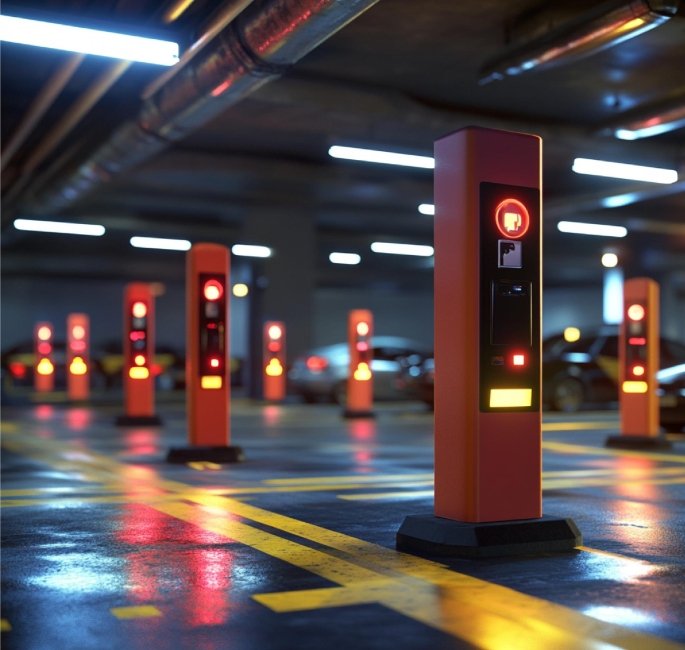
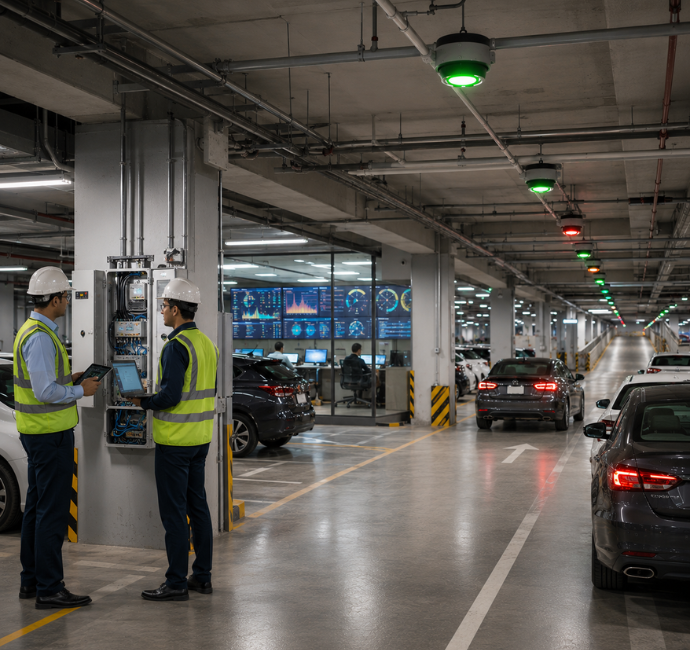
Unlike outdated manual systems, a smart parking guidance system uses ceiling-mounted ultrasonic sensors equipped with RGB LED indicators to instantly display space availability—green for vacant, red for occupied, and customized colors for reserved or accessible parking. The result is faster parking, reduced congestion, and improved operational control.
This page offers a comprehensive technical and operational overview to help facility managers, developers, and parking operators understand how an ultrasonic-based parking guidance solution improves efficiency, safety, and revenue performance.
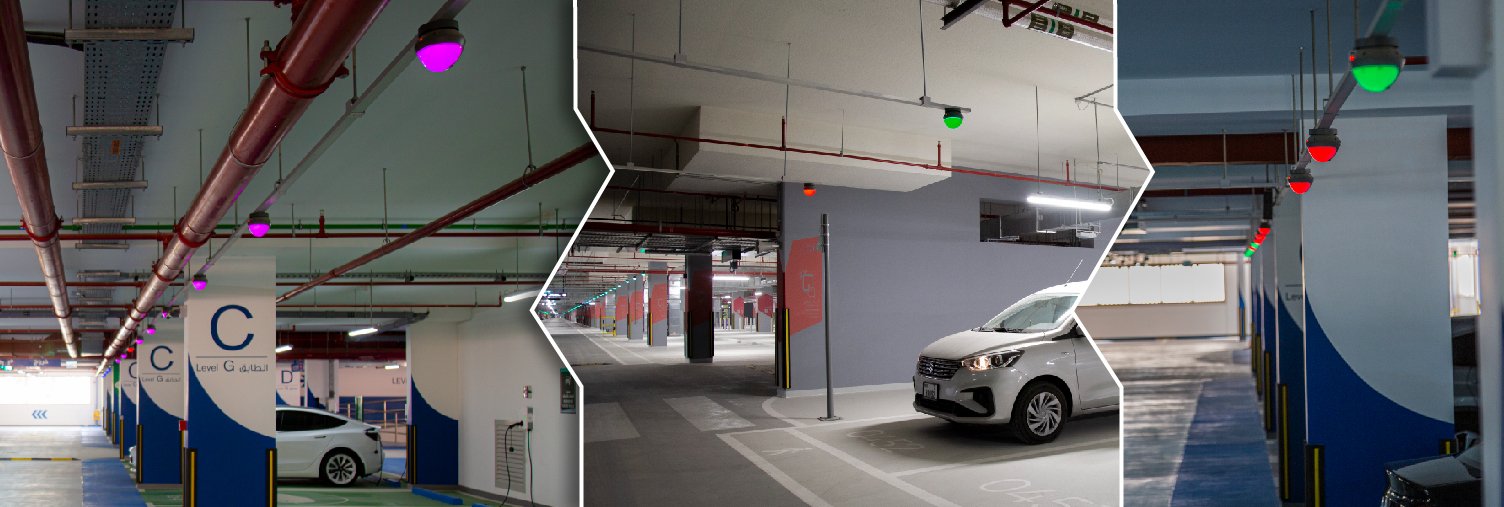
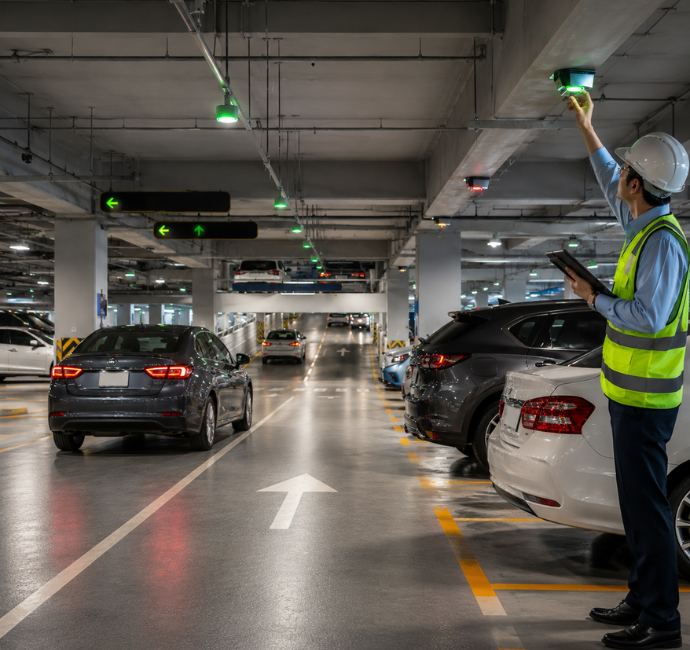
An Ultrasonic Parking Guidance System is an intelligent indoor parking management solution that detects vehicle presence in individual parking spaces using ultrasonic parking sensors. These sensors measure the distance between the sensor and the vehicle beneath it to determine occupancy status with high accuracy.
The system typically includes:
The objective of the parking guidance system is simple yet powerful:
Minimize vehicle search time and optimize space utilization in structured parking environments.
In multi-level parking structures, this becomes even more critical. A well-designed multi-level parking guidance system provides drivers with level-wise availability updates at entry points and decision nodes, reducing unnecessary vehicle circulation across floors.
From a technical standpoint, ultrasonic detection offers a reliable, lighting-independent solution ideal for indoor environments where camera-based systems may face limitations due to dust, glare, or shadowing.
Understanding the technology behind an Ultrasonic Parking Guidance System builds confidence in its reliability and performance.
1. Ultrasonic Detection Mechanism
Ultrasonic parking sensors emit high-frequency sound waves toward the parking bay. These waves reflect back to the sensor when they encounter an object (a vehicle). The system calculates the time taken for the wave to return and determines whether a space is occupied or vacant.
Key technical principles:
Because this method relies on sound reflection rather than visual recognition, it remains unaffected by:
2. Real-Time LED Indication
Each sensor is equipped with a visible RGB LED indicator:
This direct visual guidance allows drivers to identify open spaces from a distance without scanning each bay individually.
3. Data Transmission & Display
The occupancy data is transmitted to:
At key decision points, digital displays show:
This ensures structured traffic flow and eliminates random circulation.
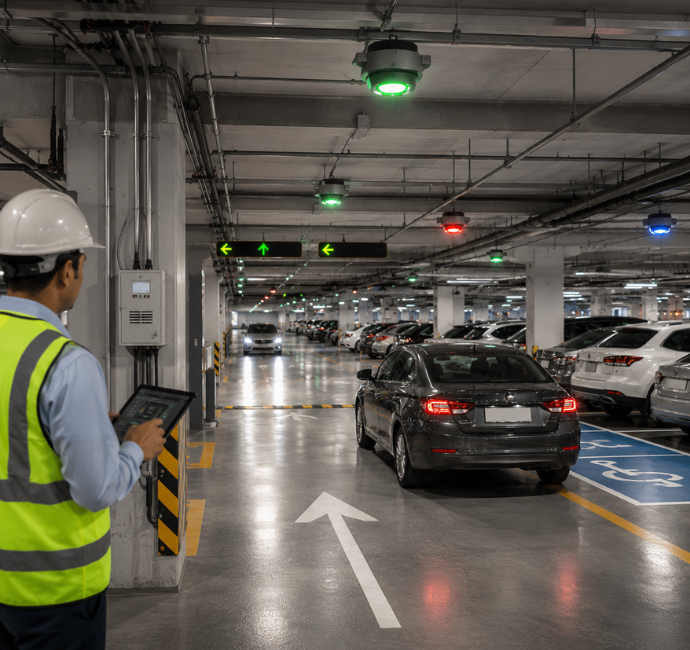
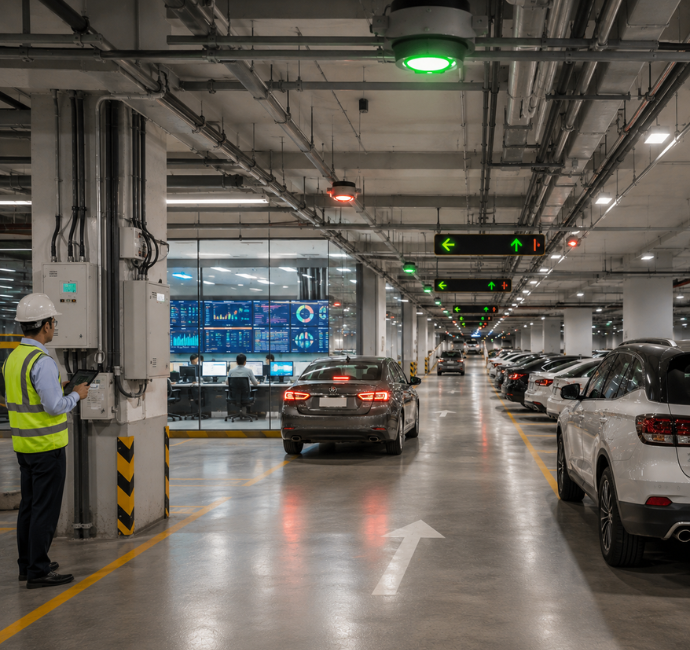
A high-performance ultrasonic parking solution consists of interconnected hardware and software elements. Each component plays a critical role in delivering a seamless parking experience.
1. Ultrasonic Parking Sensors
These ceiling-mounted devices are the foundation of the system. They:
Engineered for durability, they are resistant to:
2. Zone Controllers
Zone controllers collect occupancy data from multiple sensors within a defined section of the parking facility. They:
3. Indoor Directional Signboards
Placed at:
These LED signboards display live availability data to guide drivers efficiently.
4. Central Management Software
The central dashboard enables:
Facility managers gain full visibility and operational control through this interface.
5. Communication Network
The system can operate using:
An Ultrasonic Parking Guidance System delivers measurable operational and financial benefits. Beyond convenience, it creates tangible improvements in facility management and user satisfaction.
Operational Benefits
Financial Benefits
Environmental Benefits
User Experience Benefits
From a smart infrastructure perspective, this system forms the backbone of a modern smart parking guidance system aligned with smart city objectives.
When selecting a parking technology partner, expertise and reliability matter. Omnitec’s Ultrasonic Parking Guidance System is engineered to deliver accuracy, scalability, and long-term performance.
Engineered for Performance
Designed for Indian Infrastructure Conditions
Scalable & Future-Ready
Focus on Operational Excellence
Omnitec emphasizes:
The result is not just a parking guidance system, but a strategic infrastructure investment that improves user experience, increases operational efficiency, and supports smart mobility objectives.
An Ultrasonic Parking Guidance System uses ceiling-mounted ultrasonic parking sensors to detect whether a parking space is occupied or vacant. The sensor emits high-frequency sound waves and measures the time taken for the echo to return. Based on this calculation, the system determines occupancy status and displays it through LED indicators and digital signboards.
The data is transmitted in real time to a central dashboard, enabling facility managers to monitor space availability across the entire parking area.
Ultrasonic parking sensors used in a professional parking guidance system are highly accurate when properly installed and calibrated. Because they rely on sound wave reflection rather than visual recognition, they are not affected by lighting conditions, vehicle color, or shadow interference.
This makes ultrasonic technology particularly reliable for indoor and multi-level parking guidance systems where environmental consistency is critical.
Yes, an Ultrasonic Parking Guidance System is ideal for multi-level parking structures. It provides:
This ensures smooth vehicle flow between floors and significantly reduces search time during peak hours.
Ultrasonic systems offer several advantages in indoor parking environments:
While camera-based systems rely on image processing, ultrasonic parking sensors provide stable performance using sound-based detection, making them highly suitable for enclosed structures.
Yes. A modern smart parking guidance system can integrate with:
This integration creates a complete ecosystem that enhances operational efficiency and data-driven decision-making.
By reducing vehicle search time and improving space visibility, the system increases parking turnover and optimizes space utilization. Benefits include:
Over time, this leads to measurable improvements in both operational performance and revenue generation.
No. Ultrasonic parking sensors are designed for long-term reliability with minimal maintenance. Since they do not rely on lenses or cameras, there is no need for frequent cleaning or visual recalibration.
Routine inspections and periodic system checks are typically sufficient to ensure consistent performance, making it a low-maintenance and scalable solution for modern parking facilities.
TagMaster AB, a leading world wide producer of RFID long range readers and ANPR camera has enjoyed a long and successful cooperation with Omnitec Systems India Pvt Ltd based in Dubai. Omnitec has successfully represented TagMaster AB in UAE and we are now celebrating more than 10 years of partnership which has been an incredible journey. Your commitment to excellence and trust in Tagmaster has been the cornerstone of our success together. Here’s to many more years of collaboration!

Vice President Sales Parking/Access/ Security
TagMaster AB
We Adaptive Recognition Hungary Zrt. are proud to act as a longstanding supplier to Omnitec Security Systems L.L.C., one of our valued partners.
As a supplier, we understand the significance of consistency and quality in our offerings. Over the years, we have strived to meet and exceed Omnitec ’s expectations, delivering our products with punctuality and unwavering dedication.
We appreciate the opportunity to provide our products to Omnitec Security Systems and look forward to many more years of fruitful collaboration.

Carmen Sales Manager
Working with Omnitec Security Systems for more than 15 years has been a rewarding experience. Their commitment to quality and professionalism is unmatched which makes them a giant player in the Parking Systems Integration industry. They foster strong, transparent relationships with their suppliers, ensuring clear communication, timely payments, and a collaborative atmosphere that fosters mutual growth. It’s a pleasure to work with an organization that values its supplier relationships as highly as its customer relationships.

Founder
Omnitec is our valued partner in Dubai; thanks to their young, professional and highly enthusiastic team, Inkema has increased its presence and reputation in the Emirates, by providing excellent service and accurate professional guidance in the field of loading bay equipment and industrial doors. We look forward for many years more of fruitful cooperation!

Inkema Export Sales Area Manager for the Middle East, Asia & Pacific
Working with Omnitec Systems India Pvt Ltd has been a pleasant experience so far and it will be in the future as well. They learned me a lot about the market situation in The Middle East and together we became a good team from the beginning. Good people who know where they talk about.
Omnitec is a company with transparent communication, clear in their askings and willing to help.
Looking forward to many more years.
Senior Accountmanager
Condoor
Let’s discuss how we can work together!